
Digital visibility is no longer shaped by traditional search engines alone. Generative AI systems such as ChatGPT, Google AI Overviews, Perplexity and Microsoft Copilot are changing how users find information and which brands become visible.
This makes AEO and GEO increasingly important. Both approaches help companies structure their content so it can appear in direct answers and AI-generated recommendations.
In this article, you will learn:
-
what AEO and GEO mean,
-
how the two approaches differ,
-
how companies can improve their visibility in AI systems.

AEO or GEO? Why you need both?
The rules of digital visibility are being rewritten—and faster than many marketing teams can keep up with.
Anyone familiar with GEO already knows the core message: generative AI systems like ChatGPT, Google AI Overviews, and Perplexity are fundamentally changing how users find information and which brands gain visibility in the process. We explored this in detail in our article "GEO vs. SEO: The Rules of Visibility Are Changing."
However, GEO is not the only term emerging in the context of AI-driven search. The acronym AEO—Answer Engine Optimization—is also increasingly cropping up in professional circles. And this is precisely where confusion arises: What exactly is the difference between AEO and GEO? Where do they overlap? And what does this mean in concrete terms for businesses?
This article clears up the confusion and explains why both concepts need to be considered together.

What is AEO, and why is the term popping up everywhere now?
AEO stands for Answer Engine Optimization—the optimization of content for systems that provide direct answers rather than simply listing links.
The term is not new: discussions about structuring content so that search engines could use it as a direct answer began with the introduction of Google’s "Featured Snippets"—the so-called "Position 0" results. Voice search, Alexa, and Google Assistant have since advanced this concept.
What has changed is the increasing complexity of the systems that provide these answers. Today, it is no longer just about landing a single sentence in a Featured Snippet; it is about being recognized and cited as a relevant, trustworthy source by Large Language Models (LLMs) such as GPT-4 or Gemini.
In short: AEO describes optimization for answer-oriented systems. The goal is for your brand, product, or expertise to appear as the answer to a user's query—not buried somewhere on page two of the search results, but directly within the AI system's response text.

What is GEO, and what is the difference?
GEO stands for Generative Engine Optimization—optimization for generative AI systems that independently generate text and answers based on large language models.
In a sense, GEO is the evolution of AEO for the era of generative AI. While AEO was originally geared toward rule-based answer systems (search engine snippets, voice search), GEO focuses explicitly on AI-generated content: ChatGPT, Perplexity, Google’s AI Overviews, Microsoft Copilot, and similar systems.
The crucial difference lies in the target system and the way visibility is achieved:
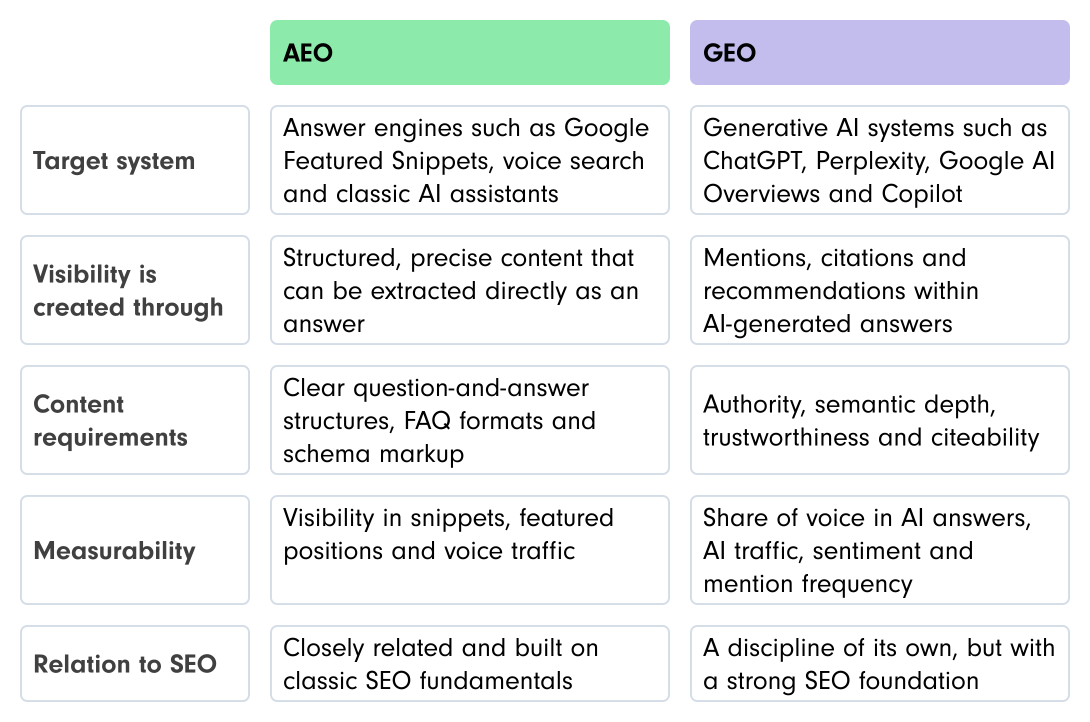
In practice, AEO and GEO are often used interchangeably; while not entirely accurate, this illustrates just how closely the two concepts are linked. Anyone optimizing for GEO is automatically working on the fundamentals of AEO.

Why is the topic relevant right now?
The answer is simple: user behavior has already changed.
According to recent studies, users are increasingly turning to AI tools as their first point of contact for information, rather than using them merely to supplement traditional search. ChatGPT records over a billion search queries per month. Google AI Overviews appear in billions of search results worldwide. Perplexity is growing rapidly as an AI search engine.
What this means for companies: the customer journey increasingly begins within an AI system rather than on a website. Those who lack visibility there lose influence over opinion formation—even before a potential customer has clicked "Search."
This effect is particularly noticeable in the B2B sector:
-
Decision-makers are increasingly using AI tools to research complex topics.
-
Information gathering often takes place anonymously and at an early stage of the buying process.
-
Being cited as an expert or a recommended provider in AI-generated answers creates a competitive advantage—long before a lead form is ever filled out.

Anyone who isn't visible today cedes the field to the competition.
We're past the 'wait and see' phase. AI tools are increasingly the first touchpoint in the B2B buying journey. Your brand either shows up in those answers – or a competitor's does.
Jenia Chornaya Senior Marketing Manager HubSpot
The bottom line: AEO and GEO are not just "nice-to-haves" for early adopters. They are strategic levers for anyone looking to secure digital visibility in the long term.

AEO and GEO: Where they overlap and where they don't
Anyone wishing to succeed in both disciplines should understand which measures have multiple effects and which are specific.
What AEO and GEO Have in Common
Content quality is the foundation of everything. For both answer engines and generative AI, the rule is the same: to be cited as a relevant source, you need content that is precise, well-structured, and factually sound. Superficial texts that rely solely on keywords are not favored by any system.
In concrete terms, this means:
-
Question-and-answer structures: Content that directly answers specific user questions is favored by both featured snippet algorithms and LLMs.
-
Semantic depth: Covering topics comprehensively and in an interconnected way, rather than just targeting individual keywords.
-
Schema markup: Structured data helps both traditional search engines and AI systems correctly categorize content.
-
E-E-A-T: Experience, Expertise, Authoritativeness, and Trustworthiness—Google’s quality criteria are more relevant than ever because AI systems rely on these signals.
How GEO goes beyond AEO
GEO entails additional requirements that extend beyond traditional AEO measures:
-
Brand presence and external mentions: AI systems learn from what is written about a brand on the web. Expert articles, PR, industry directories, and external links influence whether and how a company appears in AI-generated responses.
-
Prompt strategy: While SEO focuses on keywords, GEO centers on the prompts (user inputs) typically associated with a topic and how to optimize specifically for them.
-
Share of Voice as a new KPI: Traditional SEO rankings are difficult to measure in the context of GEO. Instead, metrics such as "How often is my brand mentioned in AI responses?" take center stage.
What does this mean in concrete terms for marketing teams?
Anyone wishing to integrate AEO and GEO into their strategy does not have to start from scratch. Many measures build directly upon a solid SEO foundation. Here are the key areas of action:
1. Make content “answer-ready”
Content needs to be structured in a way that AI systems can use it as a direct answer to a user question. This means:
- Integrate FAQ sections that address real user questions and answer them precisely.
- Write short, self-contained paragraphs that are understandable even without additional context.
- Formulate definitions and explanations clearly, as AI systems prefer well-contained answers.
- Use conversion-oriented language that reflects how people actually search.
2. Use structured data consistently
Schema markup is one of the most effective technical measures for both AEO and GEO. Relevant schema types include:
- FAQPage for question-based pages
- Article and BlogPosting for editorial content
- Organization, Person and Product for company and product pages
- HowTo for instructions and step-by-step content
3. Actively build authority and reputation
AI systems learn from what is written about a brand. Companies that want to be perceived as experts or recommended providers need to actively work on this:
- Place expert articles in relevant media
- Be present on industry portals and in directories
- Publish studies, surveys or proprietary data, as this significantly increases the likelihood of being cited
- Ensure consistent brand messaging across all channels'
4. Rethink KPIs
Visibility in AI answers cannot be fully captured with classic SEO metrics. Additional KPIs for AEO and GEO include:
- Share of voice in AI systems: How often is your brand mentioned in AI answers for relevant topics?
- AI traffic: Referral traffic from AI systems, measurable through UTM tracking and referrer analysis
- Sentiment: In what context is the brand mentioned: positive, negative or neutral?
- Prompt performance: Which search prompts lead to your brand appearing in AI answers?
.png)
16% to 26% more citations: AEO works – internationally, too.
In one of my AEO experiments at HubSpot, we measured citation rate lifts between 16% and 26% by optimizing content specifically for answer engines. Across international markets, share of voice in AI answers has become an active performance lever for us, not just a metric we observe.
Philipp Becker Senior Marketing Manager HubSpot
Tools such as Peec AI, Brandwatch or specialized GEO monitoring solutions can help measure these metrics.
5. Think of AEO, GEO and SEO as an integrated strategy
The most common mistake is to treat AEO and GEO as replacements for SEO. That is wrong. All three disciplines complement each other:
- SEO ensures technical quality, crawlability and classic ranking factors: the foundation for everything else.
- AEO ensures that content can be extracted as direct answers.
- GEO builds brand authority and presence within generative AI systems.
Anyone who neglects one of these layers loses visibility and this not at some point in the future, but already today.

Outlook: Where is this heading?
The development of AEO and GEO is still at an early stage. However, several trends are already becoming clear:
More transparency from AI providers. Google, Microsoft and OpenAI are working on better ways to make sources more visible in AI answers. This will further increase the importance of citeability.
Fragmentation of the search landscape. Google remains relevant, but Perplexity, ChatGPT Search and specialized AI tools are establishing themselves as independent sources of information. Marketing teams need to learn how to optimize for multiple systems at the same time.
Personalization of AI answers. AI systems will increasingly respond based on user behavior, industry and research phase. This makes precise audience targeting even more important in content strategy.
New measurement methods. The industry is working on standardized metrics for AI visibility. Companies that start collecting data today will have an advantage tomorrow.

Conclusion: Set the course now
AEO and GEO are not abstract, futuristic concepts; they describe what is already happening. Users are querying AI systems before clicking on websites. Purchasing decisions are influenced before a sales conversation even takes place. Brands become visible—or invisible—not through rankings, but through their citability.
The good news: If you have a solid SEO foundation and start strategically optimizing content for answer engines and generative AI, you can still set yourself apart. The race for AI visibility is real, but it has only just begun.
Want to know how your current content strategy stacks up regarding AEO and GEO? As a HubSpot partner agency, SUNZINET helps companies integrate content, marketing automation, and data strategy. Get in touch—we’ll help you take the next step.Qualitativ hochwertige Inhalte lassen sich mit KI effizient erstellen, vorausgesetzt, zentrale und relevante Grundsätze werden konsequent berücksichtigt.