

For over 15 years, the smartphone has been our central gateway to the digital world. But a new class of device is poised to replace this paradigm: AI glasses. With voice control, AR overlays, and direct integration with AI assistants, these glasses promise to make many smartphone applications obsolete. However, despite their promising advantages, several challenges remain that must be overcome for them to achieve widespread acceptance and use.
In this article we look into:
- how user behavior might change with regard to Agentic AI,
- what technological opportunities and challenges exist for Agentic e-commerce and digital visibility,
- and which systems provide solutions for the future.
Contents
- Will AI Glasses and Agentic AI revolutionize the user experience?
- What technological challenges exist?
- How important are data protection and security for trust?
- How do user experience and acceptance influence success?
- What are the effects on e-commerce and visibility?
- What long-term perspectives and trends will shape the future?
- How do companies need to adapt their marketing strategies?

Will AI Glasses and Agentic AI revolutionize the user experience?
With voice and gesture control, AI Glasses and Agentic AI will transform the user experience. Instead of constantly looking at the display, users will soon have information displayed directly in their field of vision. Functions such as navigation, messaging, shopping, and search will be seamlessly controlled via voice and gestures. This is supported by Agentic AI, an autonomous AI that proactively recognizes user needs and provides appropriate suggestions.
These Agentic AI systems are capable of independently setting goals, planning, and taking action to accomplish complex tasks with minimal human oversight – similar to intelligent digital agents.
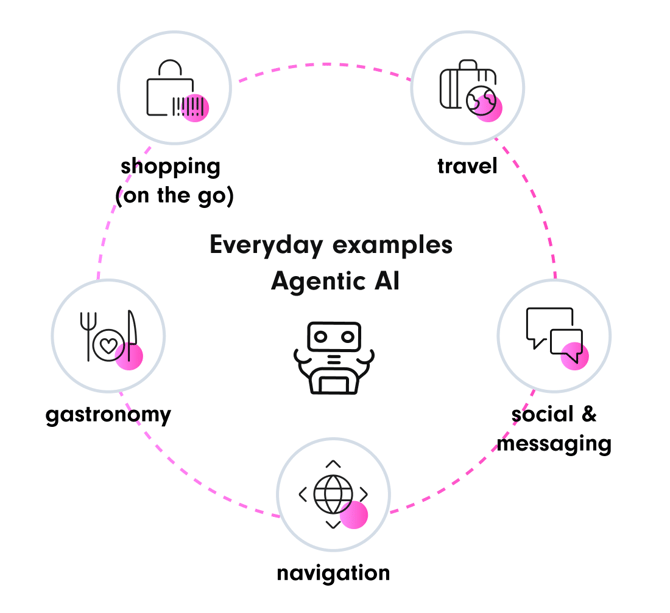
Everyday examples:
- Shopping on the go: You're walking through the city, you see a jacket you like – your glasses recognize the model and immediately display available sizes and shops. With a blink or voice command, you add it to your shopping cart.
- Travel: At the airport, your glasses automatically show you the correct gate, translate the signage, and display your boarding pass. No more fumbling for your smartphone.
- Gastronomy: You are sitting in a restaurant, looking at the menu – your glasses show you nutritional values, allergy information and reviews from other guests in real time.
- Navigation: Instead of staring at your phone, a subtle AR arrow guides you through the city, while your AI assistant simultaneously suggests the nearest café with a free table.
- Social & Messaging: Incoming messages appear unobtrusively at the edge of the screen; you can reply by voice without having to pick up a device.

AI Glasses: What technological challenges exist?
Despite their promising advantages, numerous technological challenges remain in the development of AI glasses to reach the next level of innovation. Hardware miniaturization, longer battery life, and display quality are just some of the hurdles that still need to be overcome. The integration of AI and AR into these wearable devices also requires further optimization to enhance the user experience.
Voice control and gesture control must harmonize perfectly so that the devices can be used intuitively and smoothly.

AI Glasses: How important are data protection and security for trust?
Another key issue is data privacy. AI glasses continuously collect data about the user: location information, conversations, visual impressions, and more. This data must be processed securely and responsibly to gain the trust of users.
Data protection and security protocols are becoming a critical aspect, crucial for widespread acceptance. Regulations such as the General Data Protection Regulation (GDPR) will play an increasingly important role in the use of AI glasses.

AI Glasses: How do user experience and acceptance influence success?
The acceptance of AI glasses will also depend on the user experience. Comfort, design, and social acceptance are crucial. Initially, there will certainly be skepticism towards wearable devices that constantly collect data and are visible in the environment. The user interface must also be as intuitive as possible – everything must be quick and easy to access without requiring the user to navigate a complicated menu structure. The perfect blend of comfort, performance, and aesthetics will be essential in appealing to a broad target audience.

AI Glasses: What impact will they have on e-commerce and visibility?
For brands and shops, simply having a website is no longer enough. The crucial factor is how accessible content is for AI assistants and agentic commerce systems.
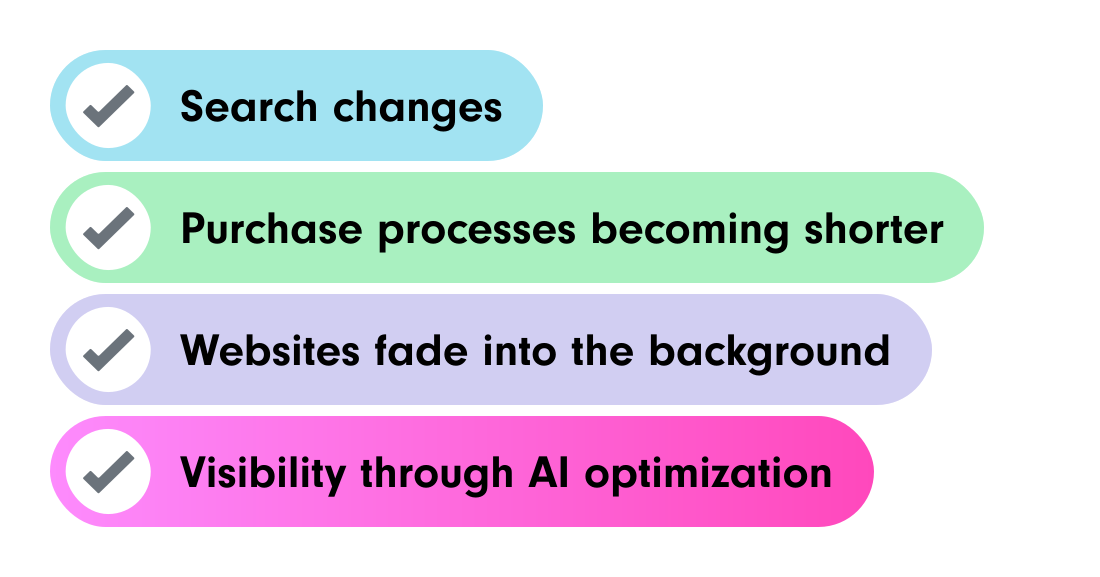
That means:
- Search is changing: Instead of Google search results, an AI agent decides which products or content are displayed. Search is increasingly being replaced by contextual and personalized recommendations from the AI assistant.
- Purchase processes are becoming shorter: From the moment of discovery to checkout, often only seconds pass, as AI proactively suggests products and offers a seamless buying experience.
- Websites recede into the background: content is filtered by agents and displayed precisely when needed. The need to browse an entire website could be significantly reduced.
- Visibility in the future will mean not only SEO, but also AI optimization: Structured data, real-time product information, and seamless interfaces will become increasingly important. AI optimization, such as GEO, will complement traditional SEO, as agents need to display relevant information instantly and precisely.

AI Glasses: What are the economic and social impacts?
AI glasses could transform a wide range of industries. Particularly in e-commerce, healthcare, tourism, and entertainment, new business models and marketing strategies will emerge. For example, digital advertisements could now be displayed directly in users' field of vision without interrupting their surroundings or activities. This interaction with the real world could pave the way for entirely new forms of targeted advertising.
AI Glasses: What long-term perspectives and trends will shape the future?
The future of AI glasses is promising, but there's still a long way to go. Future developments could include augmented reality (AR) in an even more immersive form to offer fully immersive experiences. Emotional AI, which recognizes users' moods and needs, could also play a role. Combined with other technologies like 5G or edge computing, AI glasses could become even more powerful and versatile.
Solutions for the future: Storyblok, Shopware & Shopify
To prepare for the AI glasses era, flexible systems are needed:

As a headless CMS, Storyblok enables modular and API-based content delivery. Product information or content snippets can be directly integrated into AI systems and AR interfaces – whether for product previews in glasses or personalized content overlays.

With its API-first architecture, Shopware is ideally suited for agentic commerce. The Rule Builder ensures dynamic price or content adjustments, while integrations with AI systems allow products to be suggested at precisely the right moment of use – for example, when the glasses recognize a running shoe is worn out during a morning jog and instantly surface a personalized offer for a replacement model.


How you need to adapt your marketing strategies for the digital commerce of the future
AI glasses offer enormous potential for e-commerce and digital visibility, but also bring with them a multitude of challenges, both technological and societal. Companies must address these changes early on and align their marketing strategies with the new, AI-supported world to avoid falling behind.
The future of digital commerce will be increasingly shaped by AI optimization and a seamless user experience. AI glasses not only mark a technological revolution but also a profound shift in user behavior.
Brands and companies must now begin to structure their content in a machine-understandable way and make their commerce systems fit for a future in which AI is the interface to the customer.
The good news: With systems like Storyblok, Shopware and Shopify, there are already solutions that pave the way into this new era.